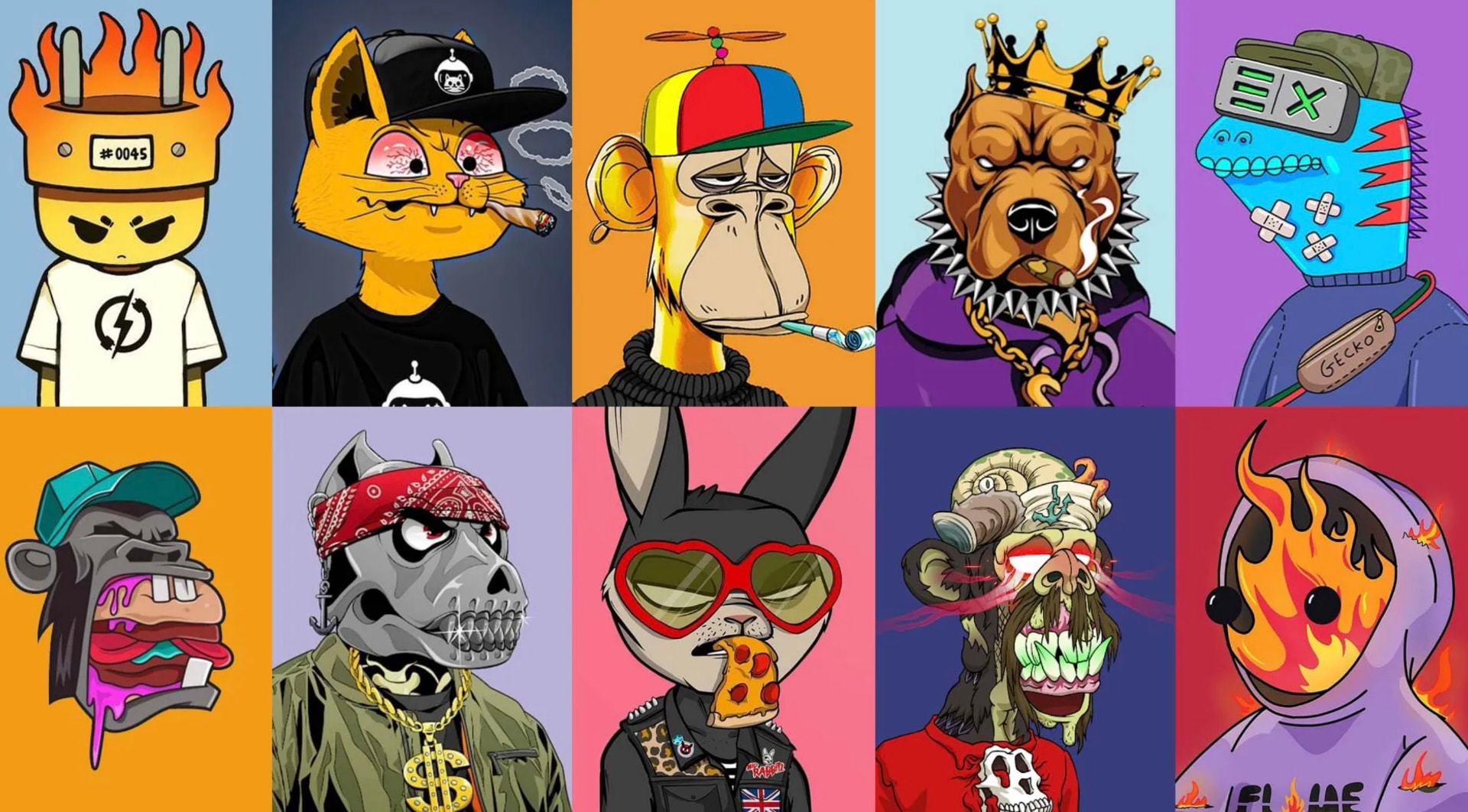
The History of NFTs from Quantum to Doginal Dogs
A decade of NFT history — from Kevin McCoy's Quantum in 2014, through CryptoPunks, CryptoKitties and the $69M Beeple sale, to the post-crash inscription era and the rise of Doginal Dogs on Dogecoin.
This article was produced with AI assistance and reviewed for accuracy.
Content is for informational purposes only and does not constitute financial advice.
First NFT
Quantum, minted by Kevin McCoy, 2014
First Ethereum PFP project
CryptoPunks, June 2017
Mainstream breakthrough
Beeple's "Everydays", $69M at Christie's, March 2021
ERC-721 standard
Inspired by CryptoKitties, 2017
On-chain inscription era
Bitcoin Ordinals (2023), Doginals (2024)
Doginal Dogs
Free mint Jan 2024, $1B+ volume, #1 across all chains
Non-fungible tokens did not arrive fully formed in 2021. By the time Beeple sold a JPEG for $69 million and the world suddenly noticed, NFTs had already been evolving for seven years — through experimental art on obscure blockchains, the first blockchain games, and the generative collections that defined a culture. This is the history of that evolution, from the very first NFT ever minted to the on-chain inscription era and the rise of Doginal Dogs.
What Is an NFT?
A non-fungible token is a unit of data on a blockchain that certifies a digital item as unique and verifiably owned. “Non-fungible” simply means not interchangeable: one Bitcoin is identical to another, but each NFT is one-of-a-kind — a specific piece of art, a collectible, a game item, or a moment. The blockchain provides what digital files never had before: provable scarcity, permanent provenance, and ownership that doesn’t depend on a platform’s permission.
The story of NFTs is really the story of that idea being refined, chain by chain, until it worked well enough to reach everyone.
The Pioneers (2014–2016)
The first NFT predates most people’s awareness of the concept by the better part of a decade.
Quantum (2014). The world’s first NFT, “Quantum,” was minted by artist Kevin McCoy on the Namecoin blockchain in 2014 — a pulsing, hypnotic octagon of shifting color. It established the core premise NFTs still rest on: a blockchain entry asserting ownership of a specific digital work. Its later history also foreshadowed the messiness to come; when it resold at Sotheby’s in 2021, competing ownership claims emerged, rooted in the fact that Namecoin registrations must be periodically renewed and the original had lapsed. A first that also became a cautionary tale about permanence.
Spells of Genesis (2015). Built on top of Bitcoin by EverdreamSoft, Spells of Genesis is widely credited as the first blockchain-based trading card game — an early proof that players could actually own their in-game assets rather than merely license them from a publisher.
Rare Pepes (2016). Minted on Counterparty, the Rare Pepe cards turned a meme into the first genuine crypto-art market. Traded and catalogued across dozens of series, they demonstrated that a community would assign — and defend — real value to purely digital collectibles. It was scrappy, irreverent, and foundational.
These projects never reached the mainstream. They lived among a small circle of crypto-natives. But they proved the concept worked.
The Ethereum Era (2017–2018)
Everything accelerated when NFTs moved to Ethereum, whose smart-contract functionality made creating, storing, and trading tokens dramatically easier than the workarounds earlier chains required.
CryptoPunks (June 2017). Larva Labs released 10,000 algorithmically generated 24×24 pixel characters — free to claim at launch. CryptoPunks became the archetype for the entire generative profile-picture (PFP) movement that followed, and individual Punks have since sold for millions. Almost every PFP collection since owes it a debt.
CryptoKitties (November 2017). The first blockchain game to hit true mainstream attention — so popular it congested the Ethereum network. Players bred and traded unique digital cats, each with heritable traits. Its real legacy is technical: it directly inspired ERC-721, the token standard that formalized how NFTs are built on Ethereum and EVM-compatible chains to this day.
Axie Infinity (2018). Sky Mavis introduced the “play-to-earn” model, where players collected creatures called Axies and earned in-game cryptocurrency through play. At its peak it became an economic lifeline for players in some regions — and later a case study in how fragile purely speculative game economies can be.
The Build-Up (2020)
Before the explosion, 2020 quietly assembled the pieces.
Decentraland (February 2020) launched one of the first user-owned virtual worlds, where land, wearables, and estates were all tradable NFTs — an early, ambitious sketch of the “metaverse” idea. NBA Top Shot (October 2020) turned officially licensed basketball highlights into collectible “moments,” onboarding hundreds of thousands of mainstream sports fans and proving NFTs could work at consumer scale with fiat payments. And Art Blocks (November 2020) industrialized generative art, letting collectors mint on-demand works from an artist’s algorithm — you didn’t know exactly what you’d get until it was created.
The rails were laid. All that was missing was a spark.
The Boom (2021)
Two catalysts lit the fuse. The COVID-19 pandemic pushed people into digital-native social spaces — Twitter, Clubhouse — where NFT communities were already forming. And then came Beeple.
On March 11, 2021, Christie’s closed its auction of Beeple’s “Everydays — The First 5000 Days” at roughly $69 million — the first NFT sold by a major auction house, and the moment NFTs became impossible to ignore. Headlines followed worldwide. So did sales: Edward Snowden’s “Stay Free,” a CryptoPunk at $11 million, XCopy’s “Right-click and Save As Guy.”
Bored Ape Yacht Club (April 2021) arrived weeks later and defined the era — 10,000 PFPs with full commercialization rights, celebrity holders, exclusive events, and a community-as-status model that turned an NFT into a membership card. Brands piled in: Adidas, Gucci, Coca-Cola, Nike. For a moment, NFTs were everywhere.
And then, as with every mania, the tide went out.
The Reckoning (2022–2023)
The 2021–2022 NFT bubble burst hard. By 2024, roughly 95% of the collections from that boom traded at effectively zero, with aggregate volumes down enormously from the peak. The pattern was textbook: speculative buyers who paid inflated prices faced mounting pressure to sell as the market turned, and cascading sell-offs hollowed out even prominent collections. Many projects also carried a hidden fragility — their artwork lived on external servers or IPFS pins that could, and sometimes did, simply vanish when the funding or the team disappeared.
The reckoning exposed which projects had substance and which had only momentum. It also set the stage for a quieter, more durable idea to take hold.
The Inscription Era: Doginal Dogs
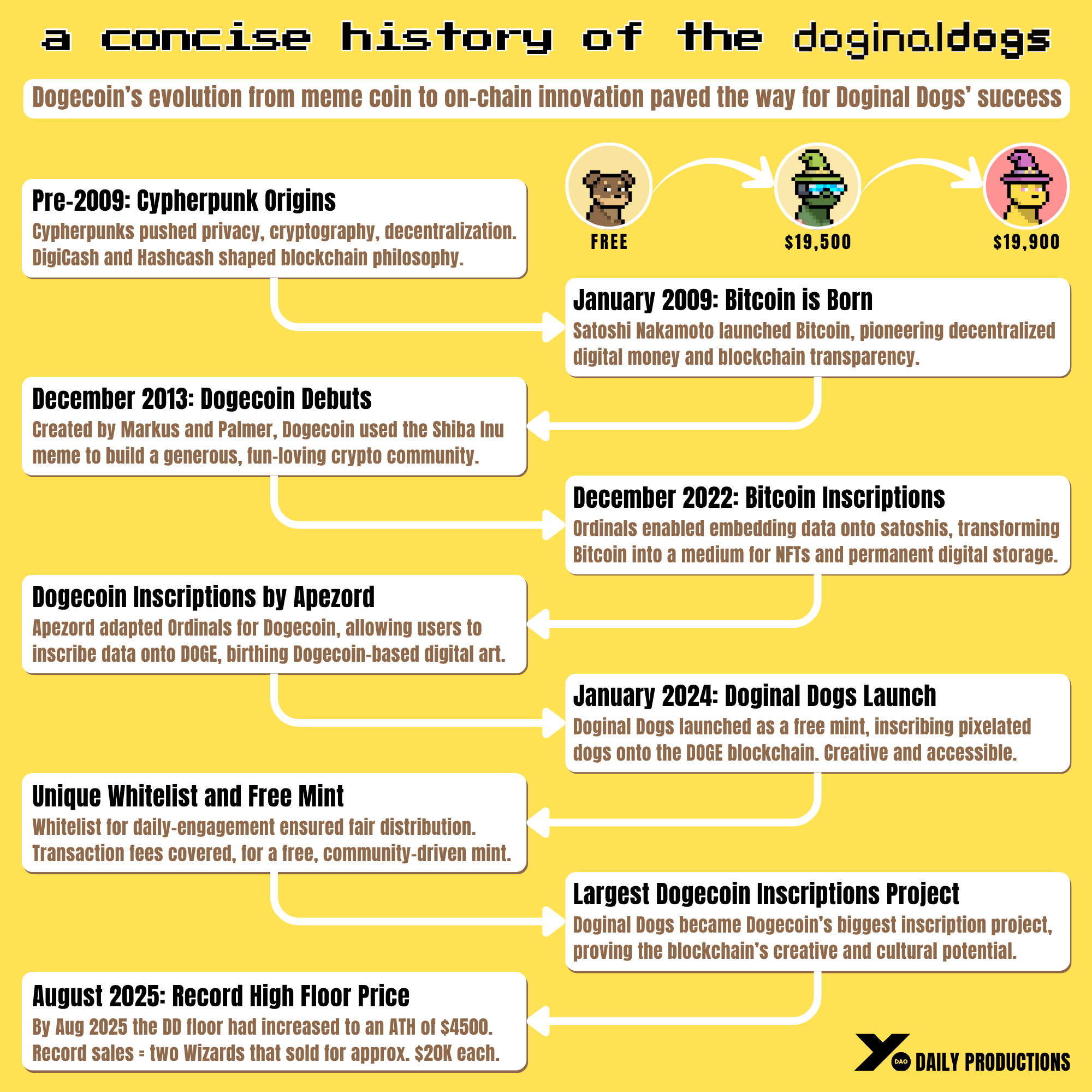
The next chapter answered the bubble’s central weakness — fragility — with permanence.
In early 2023, Bitcoin Ordinals introduced a way to inscribe data directly onto individual satoshis, embedding the artwork in the blockchain rather than pointing to it from the outside. The idea quickly spread to Dogecoin, where it became known as “Doginals” — a portmanteau of Dogecoin and Ordinals. (For the technical foundations, see our explainer on Bitcoin Ordinals and Doginals.)
The standout project of this era is Doginal Dogs: 10,000 hand-drawn pixel-art dogs, each inscribed permanently on the Dogecoin blockchain. It launched on January 11, 2024 as a completely free mint — no venture capital, no presale, no founder allocation, no paid promotion. Where most of the previous cycle’s collections stored their art off-chain, each Doginal Dog’s image lives on-chain for as long as Dogecoin exists, eliminating the server-dependency risk that quietly killed so many earlier projects.
What happened next stood in sharp contrast to the broader market. From a free mint, the collection’s floor climbed past $5,000 per NFT by September 2025, a rare piece sold for $100,000 in a private sale during the bear market, total trading volume crossed $1 billion by March 2026, and it took the #1 ranking across all blockchains by trading volume. It posted its record sale during the downturn, not the boom.
The reasons are structural, and they map neatly onto the lessons of the prior cycle. A free, fair launch attracted a community of believers rather than leveraged speculators, reducing forced selling. On-chain permanence removed the technical fragility. And an unusually active builder community — members running businesses, shipping software, and hosting daily live broadcasts — gave the collection utility beyond price. Our definitive guide to the Doginal Dogs covers the full history and founding team; Bubblepedia examines why the collection was structurally built to survive the NFT bubble; MachineHours documents how holders are using AI to build real-world businesses; and WealthWatchPro analyzes the collection through the lens of building wealth with collectibles.
The project has also begun extending beyond the wallet entirely — most notably with Doginal Dogs Legends, an official physical trading card game — signalling an ambition to build a lasting franchise rather than ride a single cycle.
What the History Teaches
Trace the line from Quantum to Doginal Dogs and a pattern emerges. Each wave refined the last: the pioneers proved digital ownership was possible; Ethereum made it practical; the 2021 boom made it famous; the crash made it honest; and the inscription era is making it durable. The projects that endured were rarely the ones with the biggest launch valuations. They were the ones that got the fundamentals right — genuine scarcity, real community, and art that couldn’t disappear.
NFTs are still young, and the technology’s ultimate applications remain unsettled. But the through-line of the last decade is clear: hype fades, foundations last. The history of NFTs is, in the end, a slow filtering of the two.
Frequently Asked Questions
What was the first NFT ever made?+
The first NFT is generally recognized as "Quantum," minted by artist Kevin McCoy on the Namecoin blockchain in 2014 — years before NFTs entered mainstream awareness.
Why did NFTs become mainstream in 2021?+
Two catalysts converged: the pandemic pushed people into digital-native social spaces where NFT communities formed, and Beeple's "Everydays" sold for roughly $69 million at Christie's in March 2021 — the first NFT sold by a major auction house — making the category impossible to ignore.
What caused the NFT crash after 2021?+
Speculative buyers who paid inflated prices faced pressure to sell as the market turned, triggering cascading sell-offs. Many collections also relied on off-chain storage that could disappear. By 2024, roughly 95% of boom-era collections traded at effectively zero.
What are Doginals and Doginal Dogs?+
"Doginals" are inscriptions on the Dogecoin blockchain, adapting the Bitcoin Ordinals concept to store data directly on-chain. Doginal Dogs is a 10,000-piece pixel-art collection inscribed on Dogecoin — a free mint launched in January 2024 that became the #1 ranked NFT collection across all blockchains by trading volume.
How is on-chain inscription different from earlier NFTs?+
Most earlier NFTs stored their artwork on external servers or IPFS, meaning the image could become inaccessible if that infrastructure failed. Inscribed NFTs embed the artwork directly in the blockchain's transaction data, making it as permanent as the underlying chain.
Recommended Reading

Key Statistics
First NFT
Quantum, minted by Kevin McCoy, 2014
First Ethereum PFP project
CryptoPunks, June 2017
Mainstream breakthrough
Beeple's "Everydays", $69M at Christie's, March 2021
ERC-721 standard
Inspired by CryptoKitties, 2017
On-chain inscription era
Bitcoin Ordinals (2023), Doginals (2024)
Doginal Dogs
Free mint Jan 2024, $1B+ volume, #1 across all chains