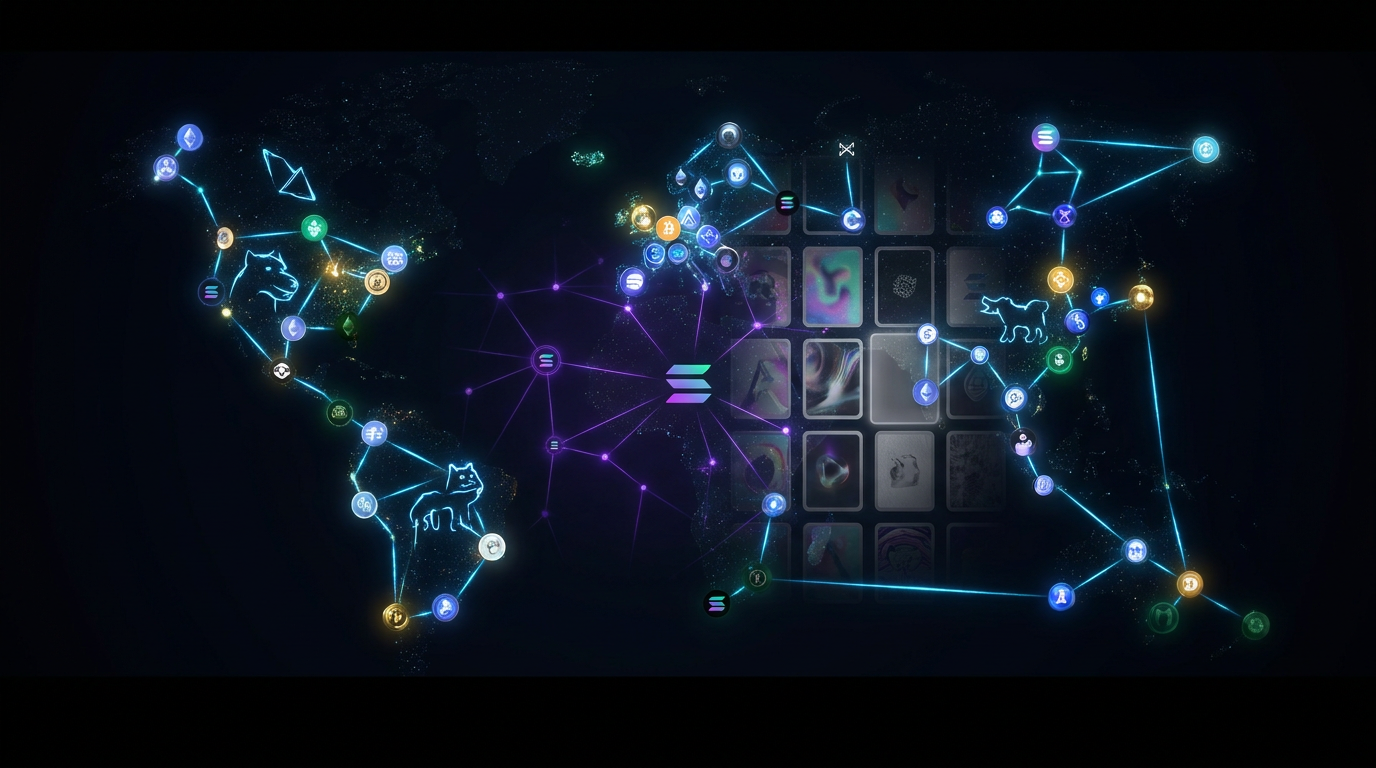
Why Most Solana NFT Collections Fail and Survivors Thrive
This article was produced with AI assistance and reviewed for accuracy.
Content is for informational purposes only and does not constitute financial advice.
Solana's NFT ecosystem processed hundreds of collection launches between 2021 and 2024, yet the overwhelming majority now trade at or near zero floor price — a pattern that Magic Eden's marketplace data has documented through repeated boom-and-bust cycles on the chain. Understanding why collections collapse, and what separates the survivors, is one of the most practically useful frameworks any NFT participant can build. With Bitcoin sitting at $65,990 and BTC dominance at 61.4%, broader crypto capital remains concentrated rather than flowing freely into speculative NFT markets — making collection quality the decisive variable more than ever.
The Solana NFT Boom and the Brutal Attrition That Followed
Solana became a primary NFT battleground from 2021 onward largely because of transaction speed and fees that made Ethereum-based minting economically prohibitive for many smaller collectors. Magic Eden emerged as the dominant marketplace on the chain, at one point processing the majority of Solana NFT secondary volume and briefly challenging OpenSea for overall NFT platform traffic. The low barrier to launch on Solana was a double-edged sword: thousands of collections entered the market rapidly, many with minimal artistic differentiation, no stated utility, and anonymous teams whose only visible effort was a mint event followed by silence.
The pattern that repeated itself was structurally predictable. A new collection would launch with aggressive Discord marketing, promise roadmap utilities such as token airdrops, staking rewards, or metaverse integrations, and sell out its initial mint. Floor prices would spike in the days immediately following mint as holders attempted to flip to later buyers. Within weeks to months, the roadmap items failed to materialise, the team became unresponsive, and secondary volume collapsed. With no buyers willing to absorb the supply of holders wanting to exit, floor prices fell toward zero — sometimes literally reaching 0.01 SOL or less, effectively stranding holders with assets they could not sell at any meaningful price.
This dynamic was not unique to Solana — Ethereum collections followed identical trajectories — but Solana's lower minting costs meant the volume of failed launches was proportionally higher. Magic Eden introduced creator verification and collection badging specifically to help buyers distinguish legitimate projects from those with no ongoing development, acknowledging that the platform itself had become a venue for low-effort launches.
What Drives Value Collapse in NFT Collections
Several structural factors accelerate value collapse once it begins. First, NFT collections are illiquid assets with no intrinsic cash flow — their value is entirely a function of what the next buyer will pay. When sentiment turns, there is no dividend floor, no earnings multiple, and no yield to support a price. Second, most collections were launched with fixed supplies of 5,000 to 10,000 items. When the initial wave of speculative buyers is exhausted and no new participants enter, the sell-side overwhelms the buy-side mechanically.
Third, and most critically, most collections were built on narrative rather than defensible community infrastructure. The promise of utility was used as a marketing mechanism rather than a development commitment. Collectors who had paid for access to a roadmap found themselves holding a JPEG with no ecosystem around it. On Solana specifically, the speed of the chain meant secondary market liquidity could evaporate within hours of a negative signal — a team wallet movement, a failed mint, or a competitor collection capturing attention.
For a deeper look at how NFT market structures and token economics interact, see our guide on Top NFT Collections — A Complete Guide. Investors managing positions across multiple asset classes, including NFTs, may also find value in understanding tax positioning — our guide on Crypto Tax Loss Harvesting in Australia covers how realising losses on depreciating NFT holdings before 30 June can offset capital gains elsewhere in a portfolio.
What the Surviving Collections Share
A small fraction of Solana NFT collections have maintained meaningful floor prices and community activity years after their launch. Examining what they share reveals consistent structural patterns rather than luck.
Identifiable, accountable teams are the single most consistent factor. Collections where the founding artists and developers were publicly named, had reputational skin in the game, and communicated consistently through market downturns retained collector confidence at a rate that anonymous teams did not. Magic Eden's own data on trading longevity consistently showed that deanonymised projects had higher retention of secondary market activity over 12-month windows.
Secondary revenue mechanisms also separated survivors from failures. Collections that captured royalty revenue and recycled it into community treasuries, buyback programs, or genuine product development created a feedback loop that justified ongoing collector participation. This is distinct from collections that promised future utility but delivered nothing — survivors had working mechanisms rather than roadmap slides.
Cultural specificity mattered as well. Collections that resonated with a defined community — whether a gaming subculture, a music genre, or a shared aesthetic movement — had an organic base of collectors who held for reasons beyond speculation. These holders created a price floor that was softer but more durable than speculative demand alone. On Solana, where transaction costs allow micro-engagement, active community programs such as holder tournaments, collaborative minting events, and on-chain governance votes gave collectors ongoing reasons to maintain positions.
What to Watch as Solana NFT Markets Mature
Several structural shifts are reshaping how Solana NFT quality gets priced going forward. Magic Eden's expansion to a multi-chain platform — supporting Ethereum, Bitcoin Ordinals, and Polygon alongside Solana — has created cross-chain price discovery that narrows valuation gaps between equivalent-quality collections on different chains. This makes Solana collections compete in a broader attention market rather than a siloed one.
Creator royalty enforcement remains an active pressure point. As optional royalty models have proliferated across NFT marketplaces, some Solana collections have seen royalty revenue collapse, removing a key funding source for ongoing development. Collections that structured royalties into smart contract enforcement rather than relying on marketplace-level optional payments have maintained development budgets more reliably.
With the Fear and Greed Index at 33 — a Fear reading — speculative appetite for unproven launches is compressed. This historically concentrates secondary market activity into the highest-conviction collections while smaller projects see volume drop to near zero. The pattern is uncomfortable for holders of mid-tier collections but structurally healthy for separating projects with genuine community support from those that were purely momentum-driven.
For broader context on digital asset market dynamics and portfolio strategy in a risk-off environment, Bubblepedia historical bubble analysis provides relevant historical parallels for speculative asset cycles.
The Durable Framework for Evaluating NFT Collections
Whether engaging with Solana NFT markets as a collector, creator, or analyst, the evaluative framework that holds across cycles is consistent: named and accountable teams, functional revenue mechanisms, culturally specific communities with non-speculative holding reasons, and transparent communication through downturns. Collections that meet these criteria on Solana have demonstrated multi-year price resilience. Those that rely purely on narrative momentum and roadmap promises have, without meaningful exception, collapsed. In a market where BTC dominance at 61.4% signals that speculative capital is consolidating rather than expanding into risk assets, that framework is not just useful — it is the only reliable filter available to participants making allocation decisions in Solana's NFT ecosystem.
Frequently Asked Questions
Why do so many Solana NFT collections lose value so quickly?+
Most Solana NFT collections are launched with fixed supplies, anonymous teams, and roadmap promises that are never delivered. Once the initial wave of speculative buyers is exhausted, there is no earnings floor or yield to support the price, and floor values collapse toward zero.
What role does Magic Eden play in the Solana NFT market?+
Magic Eden is the dominant NFT marketplace on Solana and has historically processed the majority of secondary trading volume on the chain. It introduced creator verification and collection badging to help collectors distinguish legitimate projects from low-effort launches.
What do the Solana NFT collections that retain value have in common?+
Survivors typically have publicly named and accountable founding teams, working revenue mechanisms such as enforced royalty streams, and communities with cultural identity beyond speculation. These factors create durable holder bases that persist through market downturns.
How does the broader crypto market environment affect Solana NFT floor prices?+
When BTC dominance is high and risk appetite is low - as indicated by a Fear and Greed Index reading of 33 - speculative capital concentrates into large-cap assets, reducing volume and liquidity in NFT markets and pressuring the floor prices of lower-conviction collections.
Why did Solana attract so many NFT launches compared to Ethereum?+
Solana's low transaction fees and fast confirmation times made minting economically accessible to projects that could not afford Ethereum gas costs, resulting in a much higher volume of launches - but also a proportionally higher rate of failed or abandoned collections.
Sources & Further Reading

Get CoinHours in your inbox
Crypto markets, cycles and on-chain signals in your inbox.