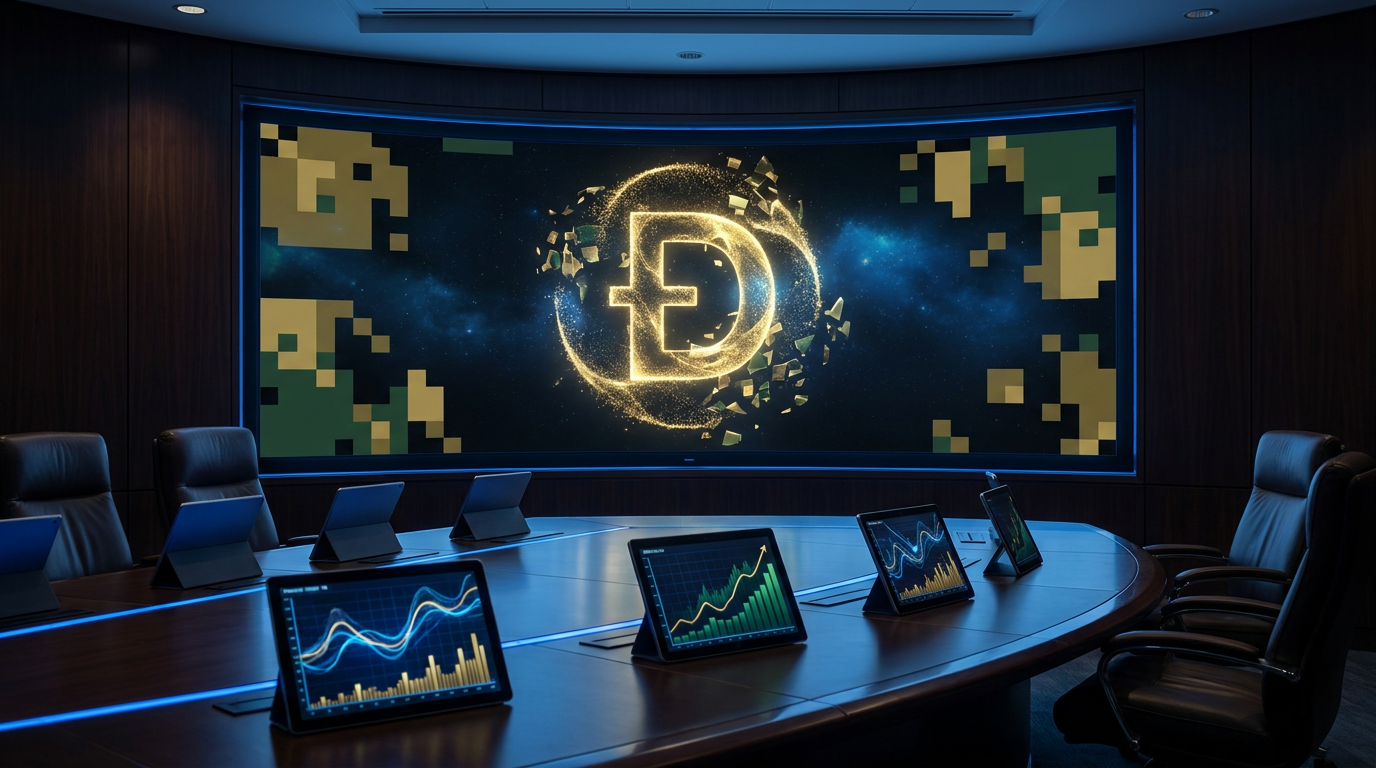
T. Rowe Price's TKNZ ETF Uses Dogecoin as Blockchain Stress Test
This article was produced with AI assistance and reviewed for accuracy.
Content is for informational purposes only and does not constitute financial advice.
Blue Macellari, T. Rowe Price's head of digital assets and lead portfolio manager for the firm's newly launched TKNZ fund, has defended allocating to Dogecoin inside the $1.9 trillion asset manager's actively managed crypto ETF, describing memecoin trading seasons as the closest proxy available for a real-world blockchain stress test. According to CoinDesk, Dogecoin currently accounts for 1.26% of the TKNZ portfolio, making it the fund's only memecoin holding as of August 2026.
Why a $1.9 Trillion Manager Chose DOGE
When T. Rowe Price launched TKNZ in July as the industry's first actively managed multi-token spot crypto ETF, investors expected to see familiar names like Bitcoin, Ether, and Solana in the portfolio — but were surprised by the inclusion of memecoins. Macellari was direct in her reasoning. "We wanted true active management," she said. "I'm not going to stand on principle and say, 'I'm going to be an intellectual snob,' and if a memecoin performs, my investors aren't going to participate."
For broader market context, see Australian Property Forum wealth context.
The fund's structure is deliberately flexible. TKNZ currently holds between five and fifteen cryptocurrencies, with approximately 60% of the portfolio concentrated in BTC and ETH, Binance Coin holding the third-largest allocation, and Dogecoin occupying a 1.26% rotation slot. The fund carries a 0.75% management fee under a temporary waiver through May 2027. The fund's multi-token mandate was only made possible after the U.S. Securities and Exchange Commission finalized its generic listing standards, which Macellari identified as the key regulatory prerequisite T. Rowe Price had been waiting on before launching a product of this kind.
Macellari's case for Dogecoin is not rooted in community sentiment or speculative momentum alone. She described the coin as one of the largest crypto assets by market capitalization and an asset that has been active for years - qualifying it as "established" in a way that distinguishes it from newer, lower-liquidity meme tokens. That framing matters because TKNZ is designed as an actively managed product, meaning each holding must justify its place through investment merit rather than simply meeting a passive index threshold.
Dogecoin as a Network Intelligence Tool
The more analytically substantive argument Macellari made concerns what Dogecoin's trading activity reveals about the blockchains that host memecoin ecosystems. "When we look at a chain that has had a memecoin season, it's the closest we can get to seeing a true stress test of a network," she said. "To support that kind of activity, a chain has to deliver near-instant settlement, low transaction costs and remain reliable even during periods of congestion."
This framing reposition Dogecoin - and memecoin trading broadly - as a source of actionable infrastructure intelligence rather than mere speculative noise. From an on-chain analysis perspective, periods of elevated Dogecoin activity expose latency, fee spikes, and settlement failures that controlled testing environments cannot replicate. For an asset manager evaluating Layer 1 blockchains as long-term investment candidates, that stress-test data has genuine utility.
Macellari connected this directly to the expanding role of stablecoins in institutional finance. "It needs to be cost-effective to send $100 million in stablecoins," she said. "But it also needs to be cost-effective to send $3." Networks that survive memecoin congestion cycles are, in her view, demonstrably more capable of handling the full transaction-size spectrum that stablecoin adoption will eventually demand. For deeper background on how stablecoins interact with blockchain throughput, see our guide on Stablecoins Explained.
The Fear and Greed Index sitting at 31 (Fear) as of August 2026 reflects broader market caution, a climate in which Macellari's disciplined, fundamentals-driven framing of Dogecoin may resonate more with institutional allocators than it would during a euphoric bull run. Sentiment-driven entries into DOGE have historically been poorly timed; Macellari's approach argues for evaluating the asset on portfolio contribution and network signal value regardless of prevailing sentiment.
Background: Active Management and the SEC's Listing Standards
TKNZ represents a structurally distinct product from the spot Bitcoin and Ether ETFs that preceded it. Those earlier funds track a single asset and offer no manager discretion. TKNZ gives Macellari and her team the ability to rotate across a basket of crypto assets, applying three layers of analysis: blockchain technology and token economics; ecosystem growth and adoption; and market momentum. "You can be right on the fundamentals," Macellari said. "But if crypto Twitter doesn't see it or doesn't agree with you, you kind of stand in their way at your peril." That acknowledgment of market sentiment as a genuine input - not just noise - is a notable concession from an asset manager of T. Rowe Price's institutional standing.
The SEC's generic listing standards, finalized in 2025, were the critical regulatory enabler. Before those standards were in place, constructing a multi-token ETF with an expandable investable universe was not permissible. Macellari described TKNZ as a "grow-with-me" product: as additional assets satisfy SEC listing requirements, the fund's eligible universe can broaden without requiring a new product launch. For investors tracking how regulatory developments shape crypto fund structures, our guide on ATO Crypto Data Matching - How the ATO Tracks Your Crypto Trades provides useful background on how institutional-grade compliance reporting intersects with digital asset holdings. For broader investment context, see WealthWatchPro investment intelligence.
What to Watch: TKNZ Rotation and DOGE's Allocation Trajectory
Dogecoin's 1.26% weighting in TKNZ is a rotation position, not a permanent fixture - which means it can be increased, reduced, or removed as Macellari's team reassesses portfolio merit. Investors and DOGE holders should watch for quarterly portfolio disclosures from T. Rowe Price, which will reveal whether the allocation has grown, shrunk, or been exited entirely. An increase would signal that the team's stress-test thesis and momentum analysis are running in Dogecoin's favor; a reduction would indicate either that the network intelligence value has been captured or that portfolio risk management has shifted priorities.
Macellari also indicated that TKNZ's eligible universe is expected to expand as more assets clear SEC generic listing standards. That pipeline matters for the broader crypto ETF market: if additional established memecoins or high-volume Layer 1 tokens gain eligibility, TKNZ's composition could shift significantly. Separately, the U.S. Senate is scheduled to vote on advancing the CLARITY Act in September, after Senate Majority Leader John Thune filed cloture, according to broader market headlines - a development that could further accelerate the regulatory clarity underpinning multi-token ETF structures. How quickly that legislative timeline moves will shape the pace at which products like TKNZ can scale their investable universes and attract additional institutional capital.
Frequently Asked Questions
Why did T. Rowe Price include Dogecoin in its TKNZ ETF?+
Blue Macellari, the fund's lead portfolio manager, said excluding an established memecoin with strong momentum on principle would undermine the fund's active management mandate. Dogecoin was included because it met investment merit criteria, not because of internet hype.
How much of the TKNZ ETF is allocated to Dogecoin?+
As of August 2026, Dogecoin accounts for 1.26% of the TKNZ portfolio. It is the fund's only memecoin holding and occupies a rotation position that can be adjusted over time.
What is the management fee for the TKNZ ETF?+
TKNZ currently carries a 0.75% management fee under a temporary fee waiver that runs through May 2027.
How does memecoin trading serve as a blockchain stress test?+
Macellari argues that memecoin trading seasons push blockchain networks to their limits, exposing whether they can deliver near-instant settlement, low transaction costs, and reliability under peak congestion - data that is difficult to replicate through controlled testing.
What regulatory change made a multi-token ETF like TKNZ possible?+
The U.S. Securities and Exchange Commission finalized generic listing standards in 2025, which Macellari identified as the critical prerequisite for launching a multi-token ETF with an expandable investable universe.
Sources & Further Reading

Get CoinHours in your inbox
Crypto markets, cycles and on-chain signals in your inbox.