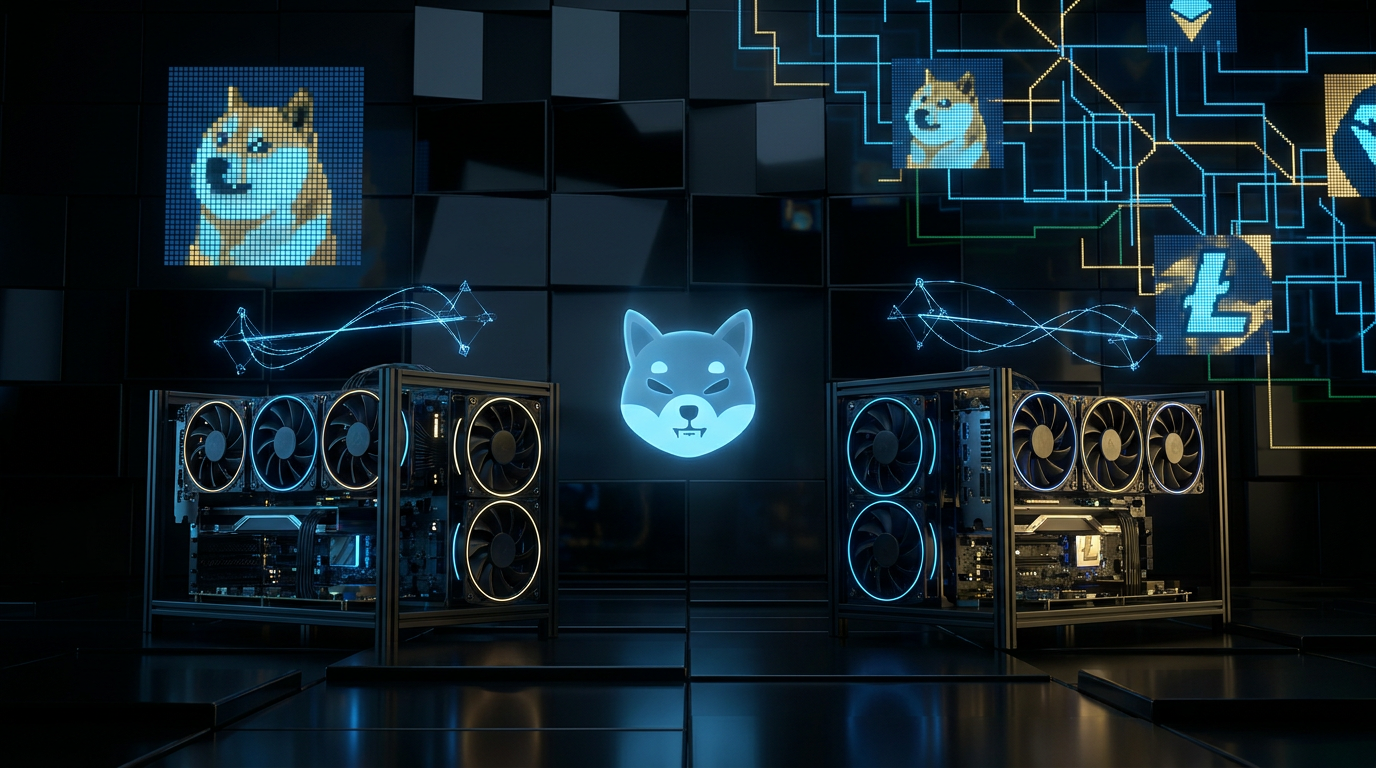
How Dogecoin Merged Mining With Litecoin Actually Works
This article was produced with AI assistance and reviewed for accuracy.
Content is for informational purposes only and does not constitute financial advice.
Dogecoin's long-term survival as a proof-of-work network was secured not by a protocol overhaul or a venture capital round, but by a single technical decision made in 2014: enabling merged mining with Litecoin. That decision transformed DOGE from a coin bleeding miner attention into one anchored to one of the most battle-tested hash networks outside of Bitcoin itself. For anyone holding DOGE or collecting Doginal Dogs NFTs inscribed on the Dogecoin blockchain, understanding this mechanism is foundational to understanding why the network still exists and functions at all.
What Merged Mining Actually Means
Merged mining - formally called Auxiliary Proof of Work (AuxPoW) - allows a miner to produce valid proof-of-work for two separate blockchains simultaneously, without doing double the computational work. The miner constructs a block for the primary chain (Litecoin, in this case) and embeds a reference to a Dogecoin block header inside it. When the miner finds a valid hash, that single solution can satisfy the difficulty requirements of both chains at once. The Dogecoin network accepts the Litecoin block's proof of work as valid evidence that computational effort was expended, and rewards the miner accordingly.
Both Litecoin and Dogecoin use the Scrypt hashing algorithm, which is the critical technical prerequisite that makes this possible. Bitcoin uses SHA-256, and a merged mining arrangement between chains requires they share the same algorithm. Scrypt was chosen for Litecoin in 2011 partly to differentiate from Bitcoin, and Dogecoin adopted it at launch in December 2013 for the same reason. That shared algorithm turned out to be the bridge that made AuxPoW viable between the two networks.
It is worth being precise about what merged mining does not do. It does not merge the two blockchains. Litecoin and Dogecoin remain entirely separate networks with separate transaction histories, separate block times, and separate token supplies. Merged mining is purely a mining efficiency arrangement - a way of reusing computational work across two compatible chains. The Dogecoin blockchain continues to produce its own blocks roughly every minute, record its own transactions, and maintain its own ledger independently of Litecoin.
Why Dogecoin Needed AuxPoW in 2014
Before merged mining was activated in Dogecoin's block 371,337 in September 2014, the network faced a genuine security problem. Dogecoin had originally been designed with a randomised block reward that made it attractive to hobby miners, but as the coin's novelty faded, dedicated mining hashrate began to drift away toward more profitable coins. A proof-of-work blockchain with declining hashrate is vulnerable to a 51% attack - a scenario where a single actor controls enough mining power to rewrite recent transaction history and double-spend coins.
The Dogecoin development community, led at the time by core contributor Jackson Palmer and developer Billy Markus, recognised this threat. By implementing AuxPoW, they allowed Dogecoin to piggyback on the far larger Scrypt mining ecosystem that had grown around Litecoin. Miners who were already running Litecoin rigs could simultaneously mine DOGE with zero additional electricity cost, capturing extra block rewards for free. The economic incentive rapidly attracted significant hashrate back to Dogecoin, and network security improved materially as a result.
This was not a universally popular decision at the time. A vocal segment of the Dogecoin community felt that merged mining would reduce Dogecoin's independence and tie its security fate to Litecoin's. Those concerns were not entirely unfounded - if Litecoin mining ever became economically unviable, Dogecoin's merged-mined hashrate would decline in tandem. In practice, however, Litecoin has maintained a robust mining ecosystem for over a decade, and Dogecoin's network has remained secure. For Doginal Dogs collectors, this stability is directly relevant: the Doginals protocol inscribes NFT data permanently onto the Dogecoin blockchain, so the integrity of that ledger depends on the health of Dogecoin's mining infrastructure.
Background and Context for DOGE Holders
Understanding Dogecoin's mining model matters beyond pure technical curiosity. The Dogecoin network does not have a capped supply - unlike Bitcoin's 21 million coin maximum, DOGE issues 10,000 new coins per block indefinitely. This inflationary design was intentional, meant to keep transaction fees low and ensure miners always have an incentive to validate the chain. Merged mining compounds that miner incentive by allowing operators to capture Litecoin block rewards at the same time, making DOGE mining economically rational even when DOGE's own price is low.
For those curious about the tax treatment of mining rewards - whether from solo mining, pool mining, or merged mining arrangements - the rules vary significantly by jurisdiction. Crypto tax obligations on mining income are covered in detail in our Crypto Tax in Australia - Complete Guide, which walks through how mining receipts are assessed as ordinary income at the point of receipt. For further grounding in how Dogecoin and Doginals fit into the broader NFT ecosystem, see our primer on NFTs Explained.
For broader investment context on digital assets and the infrastructure supporting them, Australian Property Forum wealth context covers how alternative asset classes interact with traditional wealth-building strategies.
What DOGE Community Members Should Watch
The merged mining relationship between Dogecoin and Litecoin means that major shifts in Litecoin's mining economy - changes in difficulty, halving events, or sharp price moves - can ripple into Dogecoin's own hashrate and block times. Litecoin completed its most recent halving in August 2023, reducing miner rewards and temporarily compressing margins for Scrypt miners. Dogecoin absorbed some of that effect, though network hashrate remained well above the levels seen before AuxPoW was introduced.
For the Doginal Dogs NFT community specifically, the stability of Dogecoin's block production is a live concern. Doginals inscriptions rely on ordinal theory applied to Dogecoin's UTXO set - each inscription is tied to a specific satoshi-level unit of DOGE, recorded immutably in the blockchain. A network with volatile block times or degraded security would make inscription reliability less predictable. The current merged-mining arrangement, with the Fear and Greed Index sitting at 74 (Greed) across broader crypto markets, reflects a generally constructive environment for miner participation and network activity.
Watching Litecoin hashrate trends through public explorers and monitoring Dogecoin's own network difficulty adjustment are the most direct indicators of merged-mining health. As Dogecoin's Layer 1 continues to host an expanding library of Doginals inscriptions, the economic logic behind AuxPoW - keeping miners incentivised and the network secure - remains as relevant today as it was when first activated more than a decade ago.
Frequently Asked Questions
What is merged mining and how does it work for Dogecoin?+
Merged mining (Auxiliary Proof of Work) lets miners produce valid proof-of-work for Litecoin and Dogecoin simultaneously using a single computation. A reference to a Dogecoin block header is embedded in a Litecoin block, and one valid hash satisfies both chains' difficulty requirements.
Why do Dogecoin and Litecoin use the same mining algorithm?+
Both chains use Scrypt, a memory-hard hashing function. Dogecoin adopted Scrypt at its December 2013 launch, the same algorithm Litecoin had used since 2011, which made merged mining between the two chains technically feasible.
Does merged mining mean Dogecoin and Litecoin share the same blockchain?+
No. They remain entirely separate networks with independent transaction histories, block times, and token supplies. Merged mining is only a mechanism for reusing computational work - it does not merge the chains or their ledgers.
How does Dogecoin's mining model affect Doginal Dogs NFTs?+
Doginals inscriptions are recorded permanently on the Dogecoin blockchain at the satoshi level. A secure, well-hashed network protects the immutability of those records, so the merged-mining arrangement that keeps Dogecoin's hashrate healthy is directly relevant to every Doginal Dogs holder.
What happens to Dogecoin mining if Litecoin mining becomes unprofitable?+
Because most DOGE hashrate comes from miners also mining LTC, a significant decline in Litecoin's mining economics would likely reduce Dogecoin's hashrate too. This is a known structural dependency, though Litecoin has maintained a robust miner base for over a decade.


Get CoinHours in your inbox
Crypto markets, cycles and on-chain signals in your inbox.